In 1987 Georges Perec’s novel Life A User’s Manual was published in English. One of the book’s characters is a wealthy man named Bartlebooth whose quest to find meaning in life leads him to the practice of painting. But Bartlebooth’s art-making takes an unconventional route. On completing his pictures he employs a craftsman and jigsaw puzzle maker to transform the works. As he resolves the puzzle, Bartlebooth makes his painting once more. By a convoluted technique, a conservator then reverses the craftsman’s interventions after which the artist’s original labour too is painstakingly undone. In this way, Perec presents his readers with the image of a blank sheet, and in doing so, perhaps implies a solidarity between painter and writer, both of whom might struggle with that space of potential. Some fine passages in the novel offer meditations on jigsaw puzzle makers and their work, their stealth, the tricks they use to fool the puzzler. Solving a jigsaw puzzle involves an awareness of the emerging picture and consideration of the series of contradictory divisions, the systematic damage to the picture’s integrity which is the grid of the puzzle’s form.
Notoriously, in his writing of Life A User’s Manual, Perec used constraints, sets of arbitrary rules. A hidden procedure gave birth to the 99 chapters of Life A User’s Manual, following the involutions in the lives of its many characters. And although, if one is to believe the biographical accounts, Georges Perec rarely deviated from his rules, in another sense deviation on the level of narrative is precisely what the writer’s procedure made possible.
*
Early readers of Perec’s novel in its English edition might have had their attention drawn around the same time to a particular painting by Giorgio de Chirico. Printed reproductions of The Uncertainty of the Poet were in circulation. A deal had just been proposed by the executors of the estate of Sir Roland Penrose, by which de Chirico’s painting would be given to the nation. However, when requested tax exemptions were declined the executors approached the Tate Gallery proposing to sell the work for an amount “very substantially less” than the painting’s market value.
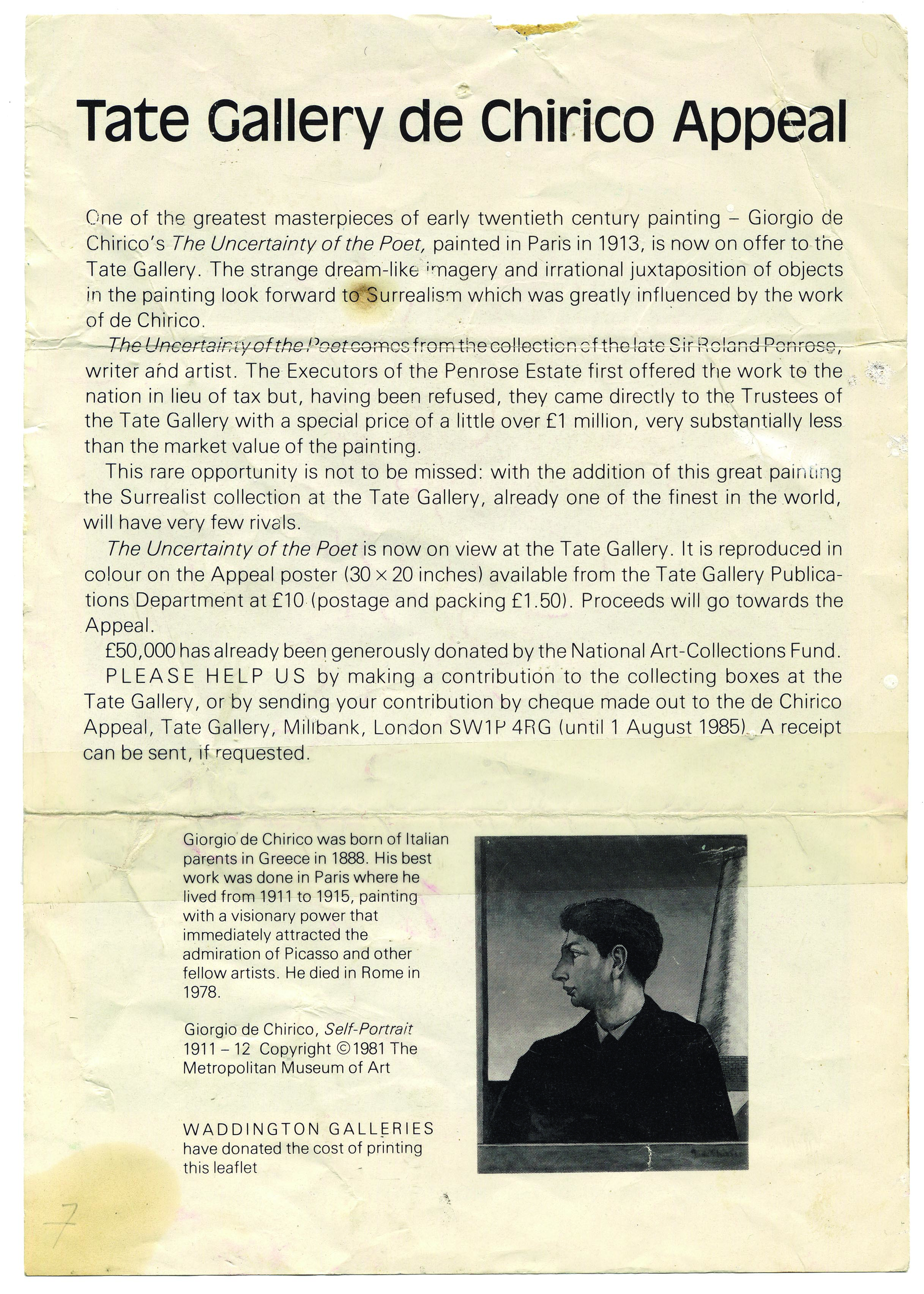
These favourable conditions for the purchase were explained on a leaflet, with the sum required for the leaflet’s printing having been donated by Waddington Galleries. Under the title Tate Gallery de Chirico Appeal a few short paragraphs provided information about the artist and vouched for the importance of this particular work as an addition to the Tate’s collection. On the other side a colour illustration showed The Uncertainty of the Poet.
Members of the public were invited to contribute to the appeal, being given a number of ways to do so. Donations could be made in cash or by cheque. In addition the Publications Department at the Tate Gallery produced an Appeal poster (30 X 20 inches, available for £10) which also presented an illustration of the painting.
The provision for contributors to give money without receiving a poster has some implications. One of these is a question about its status: was it an object for purchase in the normal sense or something more like a gift offered in return for the contributor’s generosity? Considering the then current negotiations over de Chirico’s painting, parallels might be drawn.
But whether gift or purchase, since money changed hands it would not be surprising to find that de Chirico Appeal posters have been kept. The fate of the leaflets is less certain. These were free to be picked up by whomsoever should choose and can be assumed as having had the nature of something disposable for the same reason.
Still it is the case that artefacts of uncertain value get stored and forgotten – and they do so not just in archives designed for the conservation of such things. In the domestic environment too objects accumulate, are sorted according to unknown taxonomies and are rendered invisible often as a result. Through certain chapters of his novel Georges Perec devotes attention to this same fact, writing inventories of seemingly unremarkable things, listing everyday activities undertaken.
Each surviving leaflet from the Tate Gallery’s de Chirico Appeal – with creases, tears and stains – might contribute to an inquiry. Has one remained hidden, protected between the pages of a book? Are there some lying in boxes, buried beneath miscellaneous things – amongst possessions that have remained out of sight for reasons also obscured? Or is one leaflet displayed in plain view still, pinned up with other pictures and postcards which are invisible now through their familiarity, perhaps on the wall of an artist’s studio? And what are the rules that have governed the distribution of these fragile pages? Might their movements be traced?
In the reprinting of the copy of de Chirico’s painting, its matrix of dots is made all the more apparent; the crop of its edge is emphasised by the white background in a way that, even beyond the general characteristics of photographic technique, is peculiar to lithography. Paintings hung against the whitest walls make a gentler transition with the world. But in the latter case too the grid surfaces. Throughout the history of painting the idea of an equivalence between portions of the image has continued to fight with this division; a work’s section insists on differing from itself. Printing, reprinting, and the effects of time produce divisions of a kind not anticipated by the artist – not valued by those who reproduce paintings. These qualities in the degeneration of the leaflet provide other ways of considering what painting does all the same.
Look at the damage. As Perec writes, quoting from Jules Verne in his novel’s epigraph: “look with all your eyes, look.”
 scenes•adventures•speeches•machines