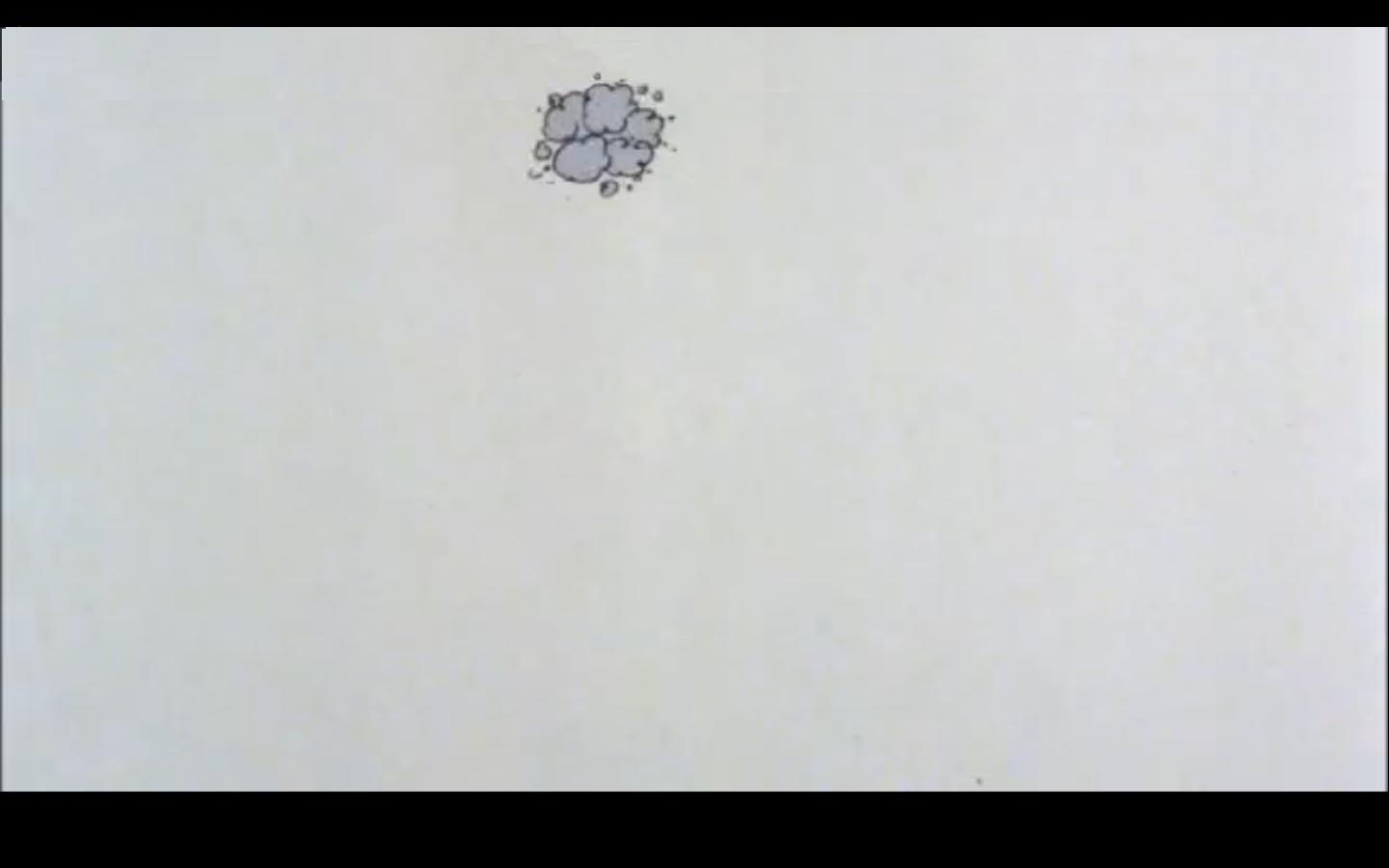
Someone is hoovering. It’s a domestic space. To begin with everything is going fine, then the nozzle gets stuck on something too large – a piece of furniture – which resists for a moment before being swallowed. Next, one by one, other pieces of furniture disappear into the hoover bag, including those things that are fixed tightly to the floor and walls, which stretch before the fixings yield. Then the pets and some family members go the same way. The building’s parts follow. And the illustrated background, like a great cloth against which the interior has been set, disappears into the hoover’s nossle. Sky, trees and hills are whisked away. Then the one doing the hooverer succumbs. Lastly, the hoover nozzle catches onto the hoover itself and the device disappears up its own tube. The culminating moment is a popping sound and a sprinkling of small particles — debris of some kind — which appears and then disappears leaving a blank expanse of white.
What does it mean that the ultimate disappearance of the hoovering mechanism, in which the world is now contained, is marked by a sound and a tiny smattering of particles? The latter is no ordinary stuff. It does not fall to the floor (there is no floor). It does not seem to be carried away on the breeze, but vanishes, having found grace to follow one last curving arc and to cross into other dimensions.
Maybe the world’s departure tells something of its arrival. The new comes as dust, the dust of the new another world, a world delivered to us in a speck, in its entirety.
 scenes•adventures•speeches•machines